

You walk through your front door every day, but the glass in that entry may still be making the wrong statement. In many Westchester homes, the foyer is beautiful, the millwork is impeccable, and the door itself is impressive. Then the sunlight glares across the stone floor, the evening exposes the interior to the street, and the only “solution” in place looks temporary.
That is where roman shades for front door applications make sense. Not as an afterthought. As a precise design decision.
For a Bronxville Tudor with leaded glass, a Rye Colonial with sidelights, or an Armonk new build with a tall, narrow glazed entry, the right Roman shade softens hard architecture, controls privacy, and finishes the room from the inside. The wrong one bunches badly, swings when the door moves, blocks hardware, or looks underscaled. The difference is design expertise and proper specification.
Elevating Your Entryway The Westchester Way
At 6 p.m. in January, a front door with glass can turn a beautiful foyer into a stage set. In July, that same glass can wash out the entry with sharp afternoon sun. Westchester homes ask more of an entry treatment because the architecture is stronger, the sightlines are longer, and the front door is often visible from the main staircase, living room, or formal hall within seconds of walking in.
Roman shades have held their place in the custom window treatment market because they solve that problem with more polish than a temporary privacy panel or a basic blind. Grand View Research’s window blinds market report points to continued demand for custom interior shading across residential projects. The reason is straightforward. Homeowners want light control and privacy without sacrificing a finished interior.
Why the front door deserves more attention
A well-designed entry sets the tone for the entire house. Ignore the glass on the front door, and even excellent millwork, flooring, and lighting can feel incomplete.
The right Roman shade adds discipline to the space.
- It corrects visual imbalance. Fabric brings needed softness to doors framed by stone, iron, stained wood, or large panes of glass.
- It keeps the entry intentional. Clean folds read as part of the interior design, not a quick fix added after move-in.
- It adapts to the architecture. A Bronxville Tudor often needs a custom-fitted shade that respects leaded glass and dark trim. A Rye Colonial benefits from a quieter fabric that keeps the foyer bright and formal. An Armonk modern entry calls for crisp lines, narrow stacking, and motorization that preserves the clean geometry of the door.
- It connects the foyer to the rest of the house. The shade can pick up a stair runner, wall color, metal finish, or upholstery palette so the entry feels designed from the inside out.
That matters in Westchester, where front doors are seldom generic. They are paneled, glazed, oversized, flanked by sidelights, or framed by original millwork that deserves a better answer than an off-the-shelf treatment.
The key question is specification
The issue is not whether a Roman shade can go on a front door. The issue is whether it has been specified for that door, that swing path, and that house.
A proper design accounts for handle clearance, mounting depth, stack location, fabric weight, and how often the door is used. In a Bronxville Tudor, the shade has to respect period character. In a Rye Colonial, it has to preserve daylight and symmetry. In an Armonk estate with smart home integration, it should operate with minimal sound and disappear when raised.
Actionable Design Tip: If your front door is visible from the street after dark, treat the Roman shade as part of the architecture of the foyer. Match the fold style, fabric, trim, and hardware clearance to the door and surrounding millwork so the treatment looks commissioned, not added later.
The Case for Roman Shades on Your Front Door
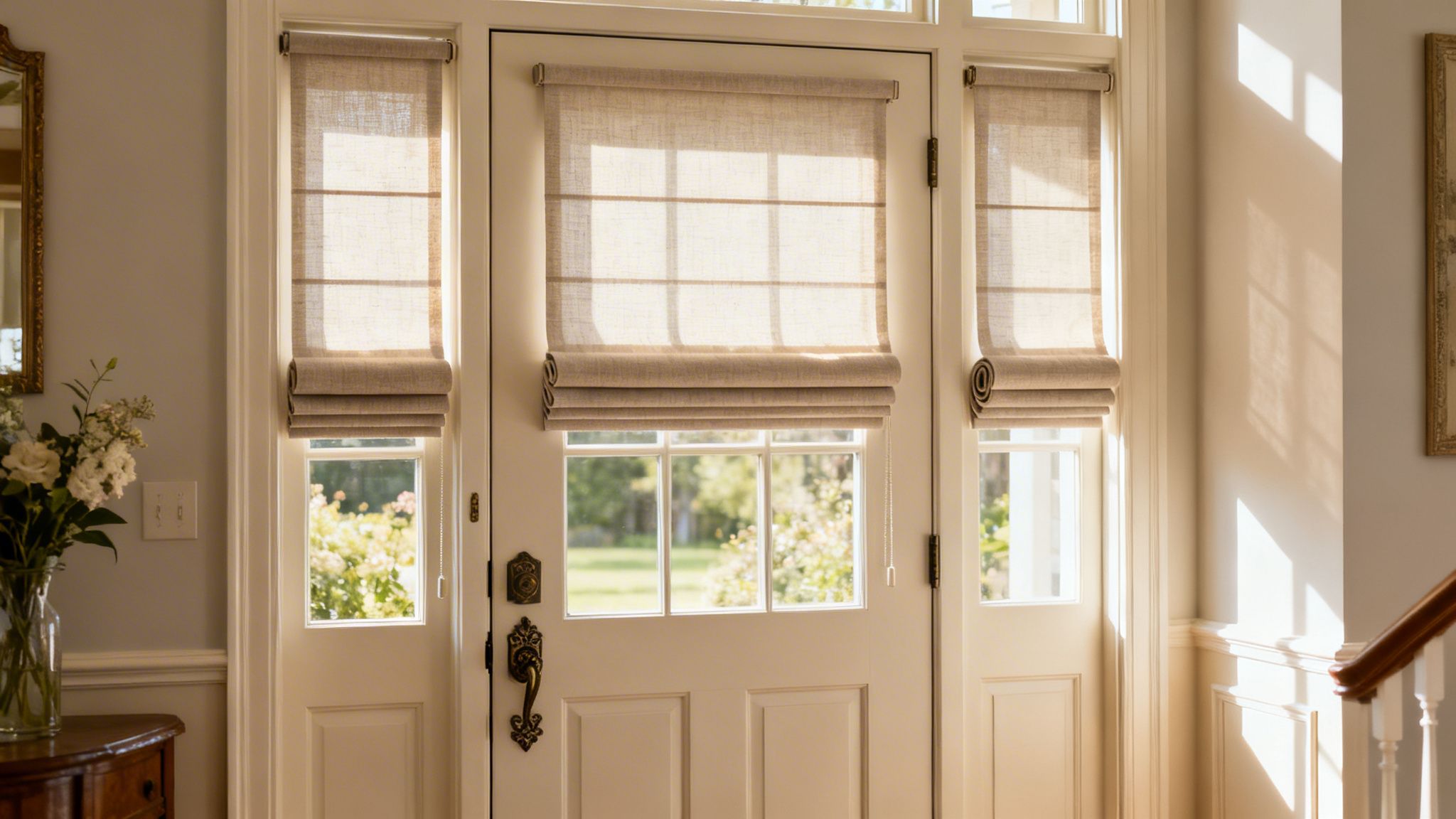
A well-designed front door in Westchester should never feel exposed at night or unfinished during the day. If your entry has glass, a Roman shade solves both problems without sacrificing the character of the door itself.
Softness where the architecture is hard
A front entry often presents as a study in hard surfaces. Painted wood. Glass. Iron. Stone. Trim. Roman shades bring in the one thing those materials often lack, which is softness with control.
That distinction matters. Drapery can feel too loose at the front door. Blinds and shutters can add visual noise to a formal foyer. A Roman shade gives you a custom layer that reads as interior design, not an afterthought.
In a Bronxville Tudor, that softer layer can temper leaded glass and dark millwork. In an Armonk contemporary, it can keep the entry precise while taking the edge off an otherwise stark composition.
They work when the door is specified correctly
The common objection is practical. Homeowners worry about handle clearance, locksets, swing path, and whether the shade will bunch awkwardly at the top.
This is avoided with correct design and professional specification.
A door shade has to be measured for projection, stack, mounting depth, and daily use. The raised shade needs enough room at the headrail to sit without crowding the glass or clipping trim. The folds also need to stack in proportion to the door’s height, so the treatment looks intentional when open and stays disciplined when lowered. For that reason, I recommend a custom front door Roman shade solution rather than adapting a standard window shade to a door application.
Professional specification also addresses a problem homeowners rarely anticipate. A front door moves. It opens, closes, vibrates, and gets used with more force than a window ever will. If the shade is not built and installed for that condition, you will see it in the folds, the alignment, and the operation.
Where Roman shades outperform other soft treatments
Roman shades perform well on doors because they stay close to the surface and keep the opening orderly.
They are a smart choice for:
- Single glazed doors, where you want privacy without interrupting the silhouette
- Sidelights, where narrow shades can create symmetry and clean vertical lines
- French door style entries, where multiple glass sections need softness without slats
- Tall, narrow inserts, where the treatment should reinforce the architecture instead of fighting it
They also respect decorative hardware better than bulkier treatments. A good design leaves the handle set prominent and keeps the fabric scaled to the glass, not the full slab of the door.
The front door exposes poor quality quickly
An inexpensive Roman shade can look acceptable on a bedroom window. On a front door, its weaknesses show readily.
The folds become uneven. The mounting looks bulky. The operation feels fussy. Sun exposure, temperature swings, and frequent handling are less forgiving at the entry than they are elsewhere in the house.
That is why the specification needs to be disciplined from the start:
| Decision point | What matters |
|---|---|
| Fold profile | It should stay crisp and proportional on a narrow vertical surface |
| Mounting | It should account for trim, jamb depth, hardware clearance, and light gaps |
| Fabric weight | It should hang without creating excessive bulk when raised |
| Operation | It should be effortless for daily use, with motorization preferred for formal entries |
Actionable Design Tip: Ask your designer to show you the raised position before approving the shade. On a front door, the open stack must clear sightlines, trim, and hardware cleanly or the treatment will never look resolved.
Designing Your Front Door Roman Shade Style and Fabric Curation
Style comes first, but performance decides whether you love the result six months later. Front door Roman shades have to do both.
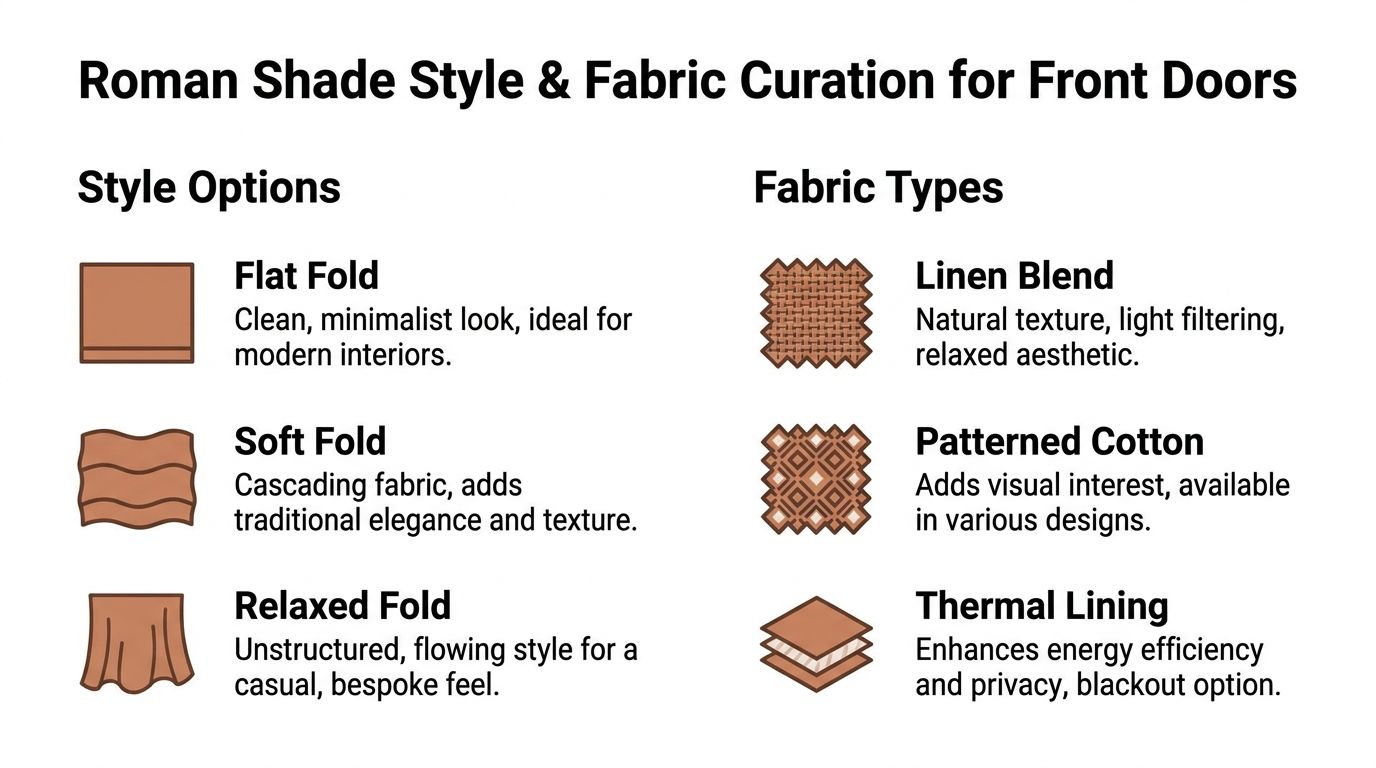
Start with the fold style
The fold determines the personality of the shade. It also determines whether the shade feels aligned with the house.
Flat fold
This is the cleanest choice. On a contemporary Rye home or a transitional renovation in Harrison, a flat fold gives you a precise plane of fabric with minimal fuss.
It works best when:
- the architecture is clean-lined
- the fabric has subtle texture or a refined pattern
- you want the entry to feel edited and quiet
Soft fold or hobbled fold
This style has more fullness and more traditional character. In a Pelham or Bronxville home with classical trim details, it can feel entirely appropriate.
Use it when:
- the foyer needs visual warmth
- adjacent rooms have layered upholstery and drapery
- you want the shade to feel more decorative from inside the home
Relaxed fold
This style can be beautiful in the right project, but I am selective with it on front doors. It has a looser, less structured character.
For a casual entry off a side porch, it may work. For a formal main entrance, I generally prefer a crisper line.
Fabric selection is not just about color
The fabric has to read well in daylight, in lamplight, and from both inside and outside. A swatch that looks ideal on a worktable can fall flat once it is hanging over bright glass.
That is why curated in-home review matters. A front door shade needs the right relationship between opacity, texture, and drape.
A few strong directions:
- Textured solids: Excellent for entries with ornate millwork or patterned tile because they add depth without visual conflict.
- Linen blends: Refined and light, particularly in lighter foyers, though they must be specified with care for structure.
- Patterned cottons or custom prints: Best when the entry needs a signature moment and the rest of the foyer is restrained.
- Performance-driven fabrics: Smart for busy family entrances where durability matters.
For design inspiration and professionally custom options, review custom Roman shades collections.
Specialty shapes need significant customization
Arched front door windows are where many treatments fail. Standard Roman shades are not built to conform to a curve, and a generic approach often leaves awkward gaps or visual imbalance.
That is why this is such an important design category. This reference on arched Roman shade demand and customization highlights the gap in standard solutions for arched front door windows. In practice, these openings require custom templating, thoughtful motorization planning, and fabrication that respects the geometry of the arch.
A grand arched entry in a Westchester estate should not be treated with a workaround. It needs a shade designed for that architecture.
Match the fabric to the way the door is used
The best front door Roman shade is not necessarily the most decorative one. It is the one that fits the actual use of the entry.
| Entry condition | Best design direction |
|---|---|
| Formal main entrance | Flat or soft fold in a refined woven texture |
| Bright south-facing foyer | Light-filtering fabric with controlled glare |
| Street-facing glass | More private liner and disciplined fold style |
| Historic arched opening | Custom-shaped solution with specific detailing |
Actionable Design Tip: During your fabric review, hold each sample vertically against the entry glass. The way a material filters daylight in that position tells you far more than a flat sample ever did.
Privacy Light Control and Energy Efficiency in the Northeast
A front door treatment that looks good and performs poorly is a mistake. In Westchester, the entry has to handle winter heat loss, summer glare, and privacy after sunset.
Privacy should be precise
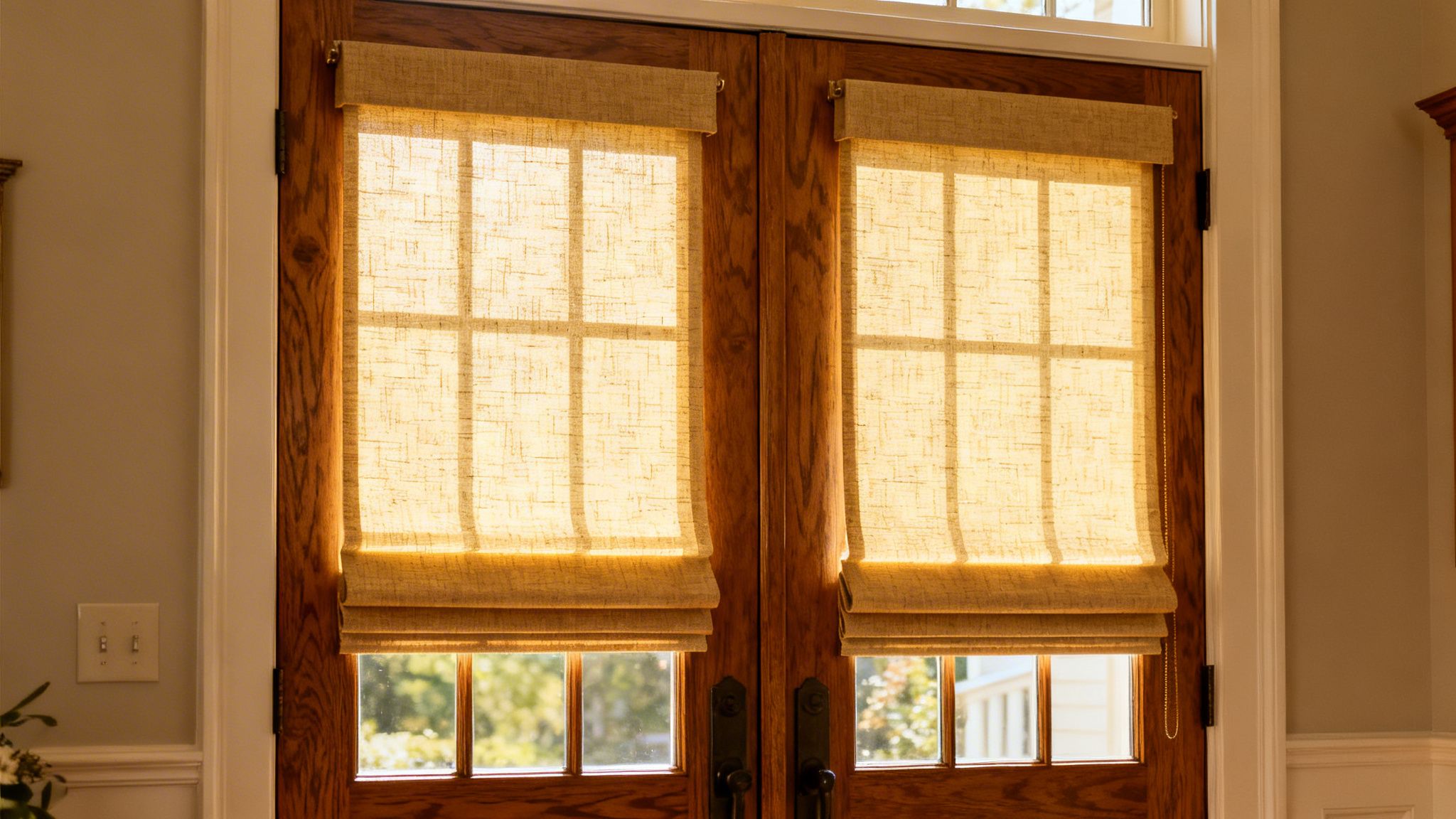
Most homeowners do not want to eliminate light at the front door. They want to stop the direct view in from the street while keeping the foyer bright.
That is where top-down/bottom-up Roman shades stand out. On the right front door or sidelight configuration, they allow you to maintain privacy where people look in most often while still preserving daylight above.
For stronger privacy and solar protection, the performance numbers are compelling. Cordless top-down/bottom-up Roman shades with blackout lining can filter 99% of harmful UV rays, and optional linings can improve thermal performance with R-values up to 3.5, according to Norman’s Roman shade guide. The same source notes that this setup can cut HVAC costs by 20% to 35% in demanding Northeast winters.
That is not a decorative detail. It is a functional upgrade for a glass-heavy entry.
Liners make the difference
Fabric alone rarely gives a front door everything it needs. The liner is often what transforms a beautiful shade into a high-performing one.
Consider the options this way:
- Light-filtering liner: Best when you want a soft glow in the foyer and moderate privacy.
- Blackout or room-darkening liner: Best for doors facing the street or close neighboring homes.
- Thermal liner: Best when the entry is draft-prone or exposed to intense seasonal temperature swings.
If you are weighing Romans against other insulating solutions, this comparison of roller shades vs cellular shades is useful for understanding where each product performs best.
Front doors need controlled light, not all-or-nothing light
Good front entry light should be intentional. Morning brightness can be welcome. Late afternoon glare may not be. Evening exposure is often the primary problem.
Roman shades give you a more nuanced response than a bare door or a static covering. With the right liner and operating system, you can soften direct sun, protect flooring and finishes, and avoid the aquarium effect that happens after dark.
Actionable Design Tip: If your front door includes sidelights, ask for a coordinated privacy strategy across all glass panels. Treating the door and sidelights as one composition almost always looks better than solving each piece separately.
Northeast performance is not optional
A glass front door in January behaves differently from one in May. The treatment has to support comfort.
That is why I do not treat Roman shades for front door applications as purely aesthetic. In this climate, they are part of the thermal envelope of the room. A beautiful entry that feels cold and exposed is not resolved.
Seamless Integration Motorization and Smart Home Automation
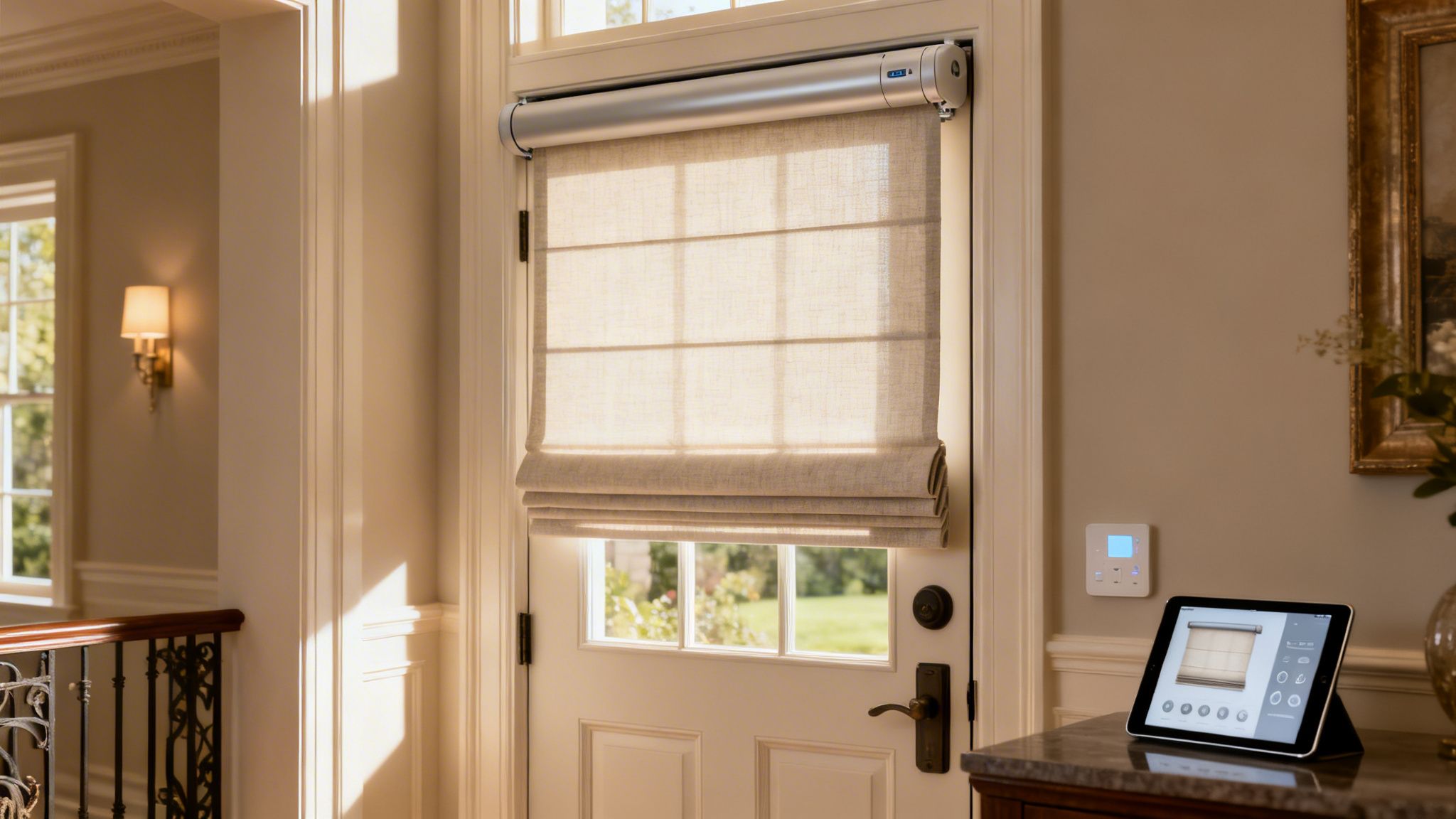
If you are still considering a manual shade for a front door, I would challenge that choice. On an active entry, motorization is not an indulgence. It is the correct specification.
Why motorization makes more sense at the entry
The front door is one of the most frequently used and most visible locations in the house. You do not want cords there. You do not want to tug fabric several times a day. You do not want a shade that is left halfway open because no one wants to fuss with it.
Motorization solves all of that.
For Westchester’s shifting light and weather conditions, custom Roman shades with integrated battens and PowerView® Automation can reduce heat gain by up to 45%, according to this reference on custom Roman shades and PowerView automation. The same source notes that the cordless motorized headrail eliminates exposed cords and supports elegant top-down/bottom-up operation.
That combination is ideal at an entry. Safer, cleaner, and more elegant in daily use.
The right systems for a luxury home
The best motorized Roman shades for front door installations integrate with the broader home, not just the opening itself.
Common high-end integrations include:
- Lutron
- Somfy
- Hunter Douglas PowerView®
- voice control through major smart assistants
- coordinated scenes within larger automation ecosystems
For homeowners planning a broader connected-home project, this overview of motorized shades and smart blinds in Armonk gives a useful perspective on how these systems fit into luxury living.
Program the shade around the way you live
Motorization becomes valuable when it disappears into routine.
In a well-planned home, you can create scenes such as:
- Morning arrival light: The shade rises to brighten the foyer after sunrise.
- Evening privacy: The shade lowers automatically at dusk.
- Away mode: The entry shade closes as part of a whole-home departure sequence.
- Entertaining mode: The foyer lighting and shade settings coordinate for a welcoming approach.
That is where a motorized front door shade stops being a gadget and starts feeling architectural.
A short look at the concept in motion helps clarify the experience:
Technical details still matter
A front door is a tougher location than a stationary window. Humidity shifts, direct sun, movement, and frequent operation all affect long-term performance.
That is why the internal construction matters:
- integrated battens keep folds aligned
- motor selection affects noise and consistency
- power planning affects cleanliness
- hold-downs and mounting choices affect stability on a moving door
Actionable Design Tip: Think in terms of scenes, not switches. A front door shade should respond to routines like sunset, leaving the house, and returning home, not merely open and close on command.
A Brief Comparison to Other Front Door Solutions
Roman shades are not the only legitimate answer for a front door. They are the most balanced answer in many homes.
Roman shades versus shutters
Plantation shutters bring architecture to the entry. They feel permanent, custom, and classic.
They are a strong fit when the house leans heavily into millwork and paneling. But on many front doors, shutters can feel heavier than the opening wants, such as when the glass area is narrow or elongated.
Roman shades do something shutters do not. They introduce fabric. That softens the foyer and connects the door to the rest of the interior furnishings.
Roman shades versus roller shades
Roller shades are clean and efficient. If your priority is a minimalist look with little visual presence, they are excellent.
But they are also more utilitarian in character. On a prominent front entry, that can read a little flat unless the architecture is modern.
Roman shades bring:
- more texture
- more decorative value
- a stronger relationship to upholstery and drapery in adjacent rooms
Roman shades versus drapery on sidelights
Drapery can be beautiful around sidelights or adjacent entry windows, but it needs room to breathe. On a frequently used front door, fabric panels can become cumbersome.
Roman shades stay close to the glass. They look composed. They avoid the casual movement and bulk that can make an entry feel overdecorated.
Which one should you choose
Here is the simplest way to decide:
| Priority | Best fit |
|---|---|
| Strong architectural statement | Plantation shutters |
| Minimal visual profile | Roller shades |
| Soft, custom, design-forward balance | Roman shades |
| Decorative side framing with more fullness | Drapery |
My advice is direct. If you want the front door to feel warm, polished, and integrated with the rest of a high-end interior, Roman shades usually win.
Actionable Design Tip: Choose the treatment that matches the character of the house first, then layer in performance needs. The most technically capable product still fails if it looks wrong at the entry.
The Westchester Window Fashions Process Your Path to Perfection
Your front door sits on display every day. In a Westchester foyer, that means the shade has to read well from the curb, from the staircase, and from the moment a guest steps inside.
That result comes from exact specification, not retail ordering.
The consultation is where the design gets resolved
The in-home consultation determines whether the finished shade looks custom-fitted to the house or added as an afterthought.
We evaluate fabric in your actual light, against your trim color, flooring, wall finish, and hardware. A Bronxville Tudor usually needs a different fabric hand and fold scale than a sleek Armonk entry with large panes of glass and harder daylight. The right choice becomes obvious once the materials are in the room.
A mobile showroom matters for this category. Front doors are exposed and architecturally specific for guesswork.
Professional specification prevents the failures that cheapen the entry
Front doors create problems that standard window treatments do not. The mounting area can be tighter. The handle and lockset limit clearance. The glass panel is narrow, tall, or interrupted by molding. The door’s movement changes how the shade behaves.
The common failures are predictable:
- shallow mounting depth that forces an awkward projection
- stack height that blocks too much glass when the shade is raised
- light gaps that weaken privacy at night
- fabric weight that looks heavy on a small glass insert
- movement and shifting when the door opens and closes
Each one affects the final impression. A beautiful fabric cannot rescue a poor specification.
As noted previously, careful mounting strategy helps reduce light seepage at the sides and keeps the treatment tight to the glass. Professional installation also matters because front door shades have to sit properly, operate without issue, and clear the hardware without looking crowded.
What a refined process should include
A proper process covers design, engineering, and installation detail.
It should include:
- Architectural review: door style, casing, glass shape, and hardware placement
- Fabric curation in place: materials assessed in daylight and evening light, not under showroom lighting
- Mounting strategy: inside mount or outside mount selected for privacy, proportion, and clearance
- Operation planning: motorization, controls, charging access, and daily use patterns resolved before fabrication
- Installation detailing: brackets, alignment, hold-downs if needed, and finish work handled cleanly
Motorization deserves special attention. On a front door, it is frequently the right answer. It eliminates tugging on fabric, keeps the folds more consistent, and gives the entry a cleaner, more polished experience.
The finished result should feel fully integrated
The best front door Roman shade looks settled into the architecture from day one. The folds are scaled appropriately. The stack sits where it should. The fabric suits the house. Privacy is handled without making the glass feel smothered.
That is the standard.
Actionable Design Tip: Before your consultation, pull five to seven entry images that reflect your taste. Keep the group tight. A focused reference set reveals whether you prefer crisp custom-fitting, softer texture, stronger privacy, or a more formal front-door presence.
Schedule your Complimentary In-Home Design Consultation in Westchester with Westchester Window Fashions to explore custom roman shades for front door applications suited to your architecture, lighting, and lifestyle. We bring the showroom to your home, guide the design with precision, and deliver a professionally installed result that looks as refined as the rest of your interior.


