

Late afternoon light can be the making of a room in Westchester. It can also be the reason you stop using it.
A Scarsdale great room may glow beautifully for an hour, then turn hostile to television viewing, laptop work, and quiet conversation. In a Rye Tudor, the problem often arrives differently. Heat builds along one wall, antiques and rugs take the punishment, and the room never feels settled during a bright July stretch.
That is why discerning homeowners rarely ask for “just blinds” once they have lived with strong sun exposure. They are looking for control. They want to protect finishes, preserve views, reduce glare, support comfort in both summer and winter, and keep the design language of the home intact. Sun blocking blinds shades do all of that when they are selected and installed as a custom system rather than treated like a commodity.
Beyond the Glare Mastering Sunlight in Your Westchester Home
In Westchester, sunlight issues are rarely generic. A center-hall Colonial in Bronxville faces different conditions than a newer glass-heavy renovation in Armonk. The architecture changes the problem. So does the way you live in the space.
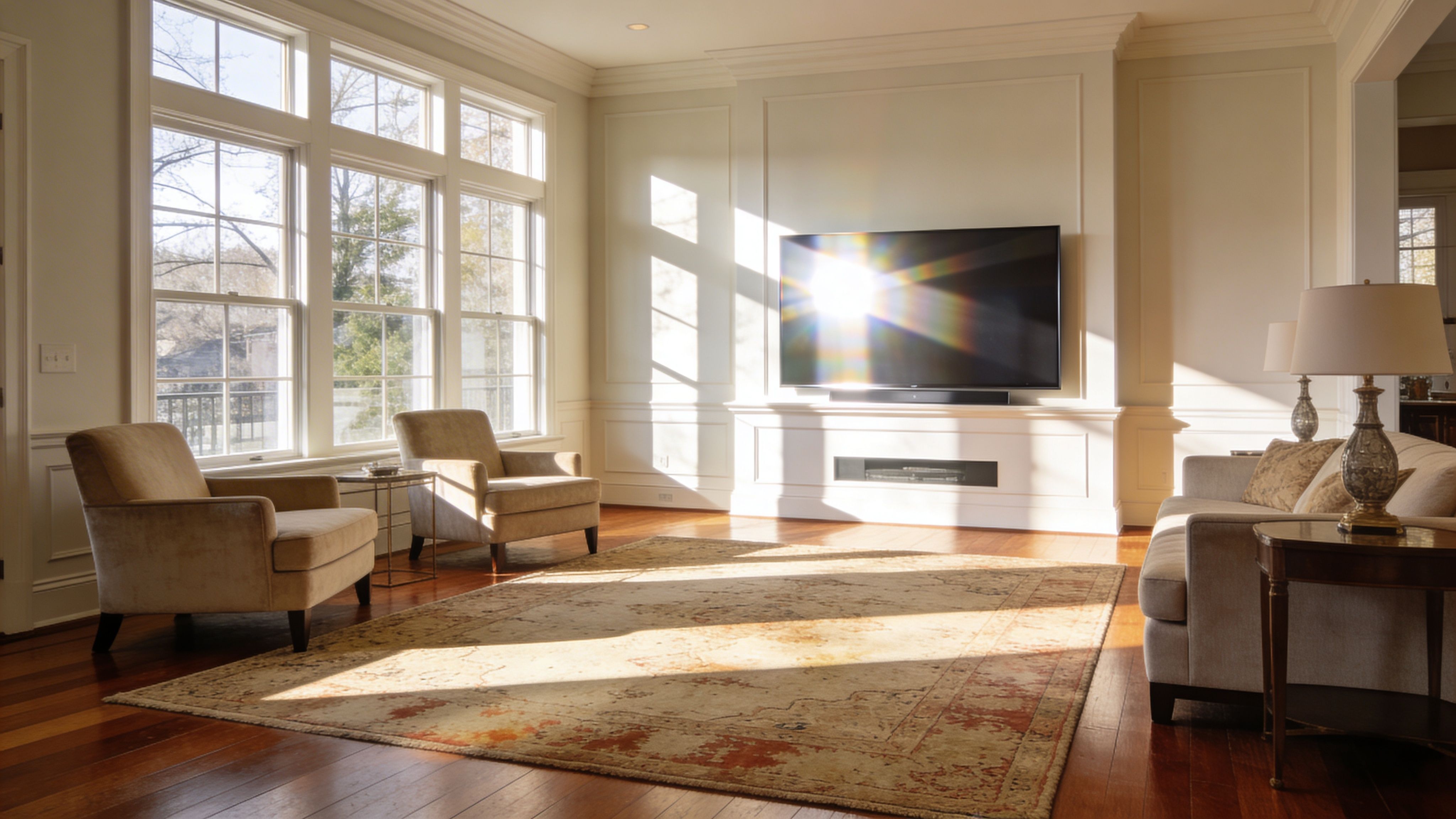
We often see the same pattern in open-plan family rooms. Morning light is welcome, but by afternoon the television is washed out, the sofa nearest the window runs warm, and the flooring nearest the glass begins to show the long-term effect of sun exposure. The room still looks elegant. It just stops functioning the way it should.
Historic homes present another version of the same issue. In older properties across Rye and Larchmont, beautiful windows can also be the weakest thermal point in the room. Homeowners try to solve that with a decorative layer alone, then wonder why glare remains and comfort never quite improves. Fabric without performance rarely solves a performance problem.
Sun control is a design decision
The most successful projects start by treating light as part of the interior architecture. That means asking better questions than “Do you want light filtering or blackout?”
We look at how each room behaves across the day:
- Media spaces: Persistent screen glare calls for stronger light management and tighter control.
- Formal living rooms: View preservation may matter as much as UV protection.
- Primary suites: Comfort, privacy, and a softer visual finish usually need to work together.
- Skylit or angled spaces: Specialty windows often need motorization and precise fabrication to function gracefully.
A homeowner in Greenwich may want to preserve a garden view while reducing solar intensity. A family in White Plains may need a nursery to remain comfortable through naps and early bedtime. Those are very different design briefs, even if both begin with the phrase “sun blocking blinds shades.”
Actionable Design Tip: Before selecting any window treatment, identify the room’s primary frustration first. If the problem is glare, your solution will differ from a room where the true issue is heat buildup, fading, or privacy after dark.
What Defines a True Sun Blocking Window Treatment
A true sun blocking treatment does more than dim a room. It manages visible light, UV exposure, and solar heat gain at the same time.
That distinction matters because many products look similar from across the room. Their performance can be very different once the sun hits the glass.
Openness tells you how a solar shade behaves
In solar shade design, openness percentage is the starting point. It describes how tightly the fabric is woven, and that weave directly affects view-through, glare control, privacy, and UV protection.
According to JC Licht’s explanation of solar shade openness percentages, tightly woven solar shades with 3% to 5% openness provide superior energy efficiency and daytime privacy, and high-performance fabrics can achieve a Solar Heat Gain Coefficient ranging from 0.13 to 0.39.
A lower openness fabric acts more like a fine screen. It blocks more light and generally gives you stronger glare control. A more open weave preserves a clearer outdoor view, but it allows more light through. Neither is universally right. The right specification depends on the room.
UV protection is about preservation
When homeowners say they want to “block the sun,” they often mean they want to stop damage. That usually points to UV control.
A tightly specified solar fabric can protect rugs, wood floors, upholstery, and art from the kind of gradual fading that is easy to ignore until it is not. In a sun-facing sitting room, that protection can matter just as much as comfort.
Heat control is separate from darkness
Many people assume the darkest-looking product will automatically be the strongest performer against heat. That is not always the case.
A fabric can reduce glare very effectively and still be less efficient at rejecting heat than a more technical textile. Performance metrics are important here. SHGC, or Solar Heat Gain Coefficient, tells you how much solar heat passes through. Lower values indicate stronger heat reduction, which is especially relevant in Westchester homes with broad exposures and large glazed openings.
Not every room needs the same answer
Many off-the-shelf decisions fall short here. A west-facing family room, a formal dining room, and a bedroom may all need “sun blocking,” but not in the same way.
A useful shorthand is this:
- Need the view: Consider solar shades with a carefully selected openness
- Need insulation first: Cellular shades are often the stronger direction
- Need darkness and privacy: Opaque or blackout materials are usually the better fit
- Need both style and layered performance: Pairing shade systems with drapery often gives the cleanest result
Homeowners comparing these categories often find our discussion of roller shades vs cellular shades helpful because the visual simplicity can be similar while the room performance is not.
Actionable Design Tip: Ask to review fabric performance before you review color. A beautiful textile that does not solve glare or heat is decorative, not corrective.
A Curated Guide to Sun Blocking Blinds and Shades
Product selection works best when it is tied to a real room, not a showroom category. In Westchester, the strongest solutions usually come from matching the treatment to the exposure, architecture, and the way the room is used.
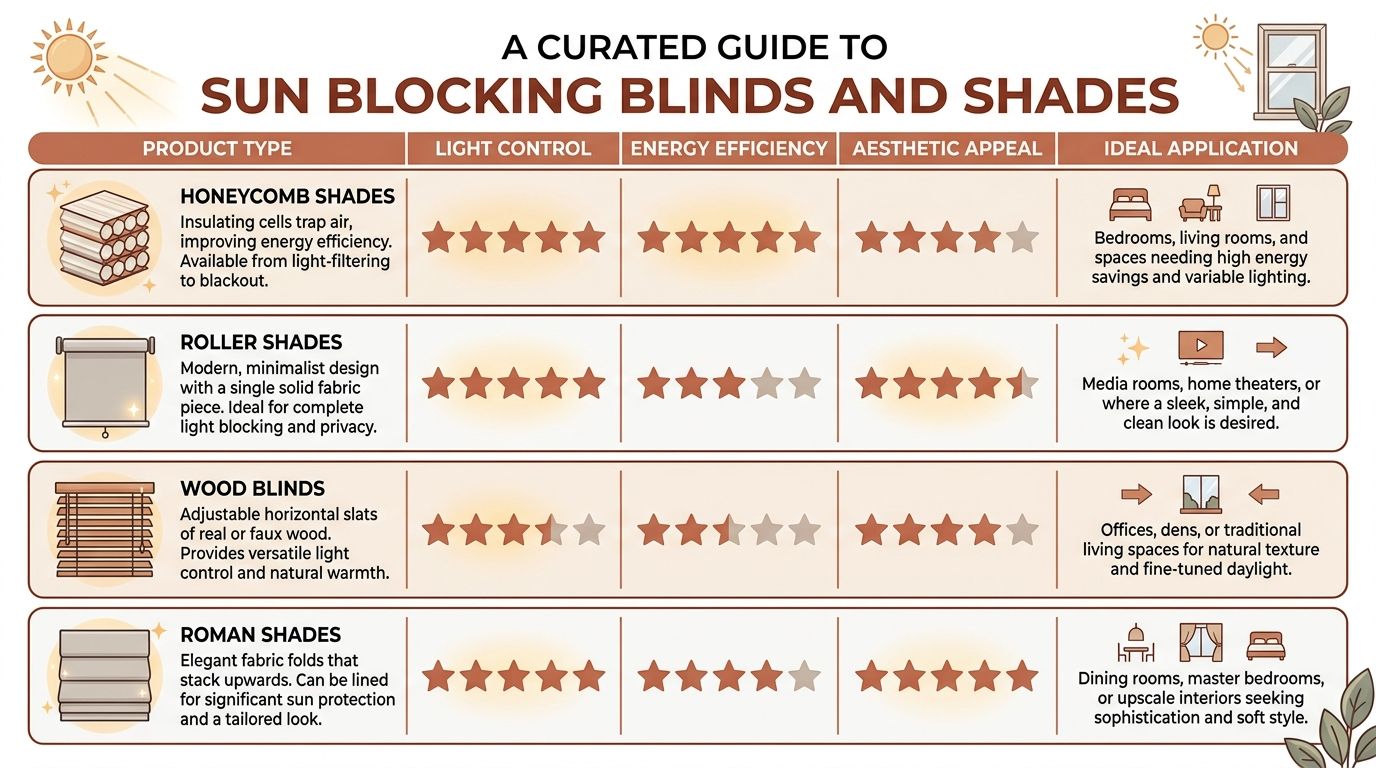
Solar shades for view-first rooms
Solar shades are often the right answer when you want sun control without losing the outdoor view. They are especially effective in living rooms, home offices, kitchens with breakfast areas, and family rooms with large expanses of glass.
According to Insolroll’s explanation of how solar screen shades work, a 1% openness factor fabric blocks about 99% of UV rays, while a 10% openness factor provides 90% UV rejection and maximizes view-through. The same source notes that dark fabrics excel at glare control, while light fabrics are superior for reflecting heat.
That trade-off is where product selection becomes nuanced. In a media room with windows, a darker and tighter solar fabric often performs better because it cuts the visual disturbance that makes screens difficult to enjoy. In a bright living room overlooking a garden in Armonk, a lighter fabric may be preferable when heat rejection matters more than aggressive glare suppression.
For homeowners exploring custom solar shades for glare control and view preservation, the key is not just choosing “solar.” It is choosing the correct openness, color, and mounting strategy for the room.
Actionable Design Tip: If preserving the view is essential, start with solar shades. Then decide whether your room needs tighter glare control or stronger heat reflection, because fabric color changes that balance.
Cellular shades for insulation-driven spaces
Cellular shades solve a different problem. They are the product we discuss when a room feels thermally unsettled, not just visually bright.
This matters in older Westchester homes with draft-prone windows, as well as in newer homes where large glazing areas create seasonal discomfort. Bedrooms, nurseries, upper-story guest rooms, and spaces over garages often benefit from cellular construction because the shade contributes meaningful softness and insulation.
They are also useful when homeowners want a quieter visual line than drapery but stronger privacy and room-darkening potential than a screen fabric can offer. In a north-facing primary bedroom, for example, the issue may not be harsh glare. It may be winter comfort and a calmer sleep environment. Cellular shades address that more directly than solar shades.
Aesthetic note matters here too. Cellular shades have a gentler, more textural presence than many homeowners expect. In painted Colonials and updated Tudors, they can disappear cleanly into the architecture when specified well.
Actionable Design Tip: If one room is uncomfortable in both summer and winter, discuss cellular shades early. That pattern usually points to insulation needs, not just light control.
Roller shades for clean-lined blackout and layered flexibility
Roller shades are often the most versatile category in a design sense. They can look spare and architectural in a modern renovation, or they can disappear behind a decorative treatment in a more traditional home.
Where they shine is control. If a client wants a crisp profile, dependable privacy, and a clean fascia, roller shades are often the right backbone layer. In bedrooms, media rooms, and guest suites, an opaque or blackout roller can solve direct sun issues and support privacy after dark in a way a solar shade cannot.
They also work well in layered schemes. In a Chappaqua family room, for example, a solar shade may handle the daytime glare, while side panels complete the room visually. In a bedroom, the roller shade may become the primary performance element, with drapery softening the elevation and adding decorative weight.
What does not work is forcing one roller fabric specification across an entire house. A whole-home look can remain consistent while the fabric performance changes room by room. That is usually the hallmark of a well-designed project.
Wood and faux wood blinds for directional control
Blinds still have a place in sun management, especially where homeowners want the ability to tilt light rather than fully filter it through fabric.
They are useful in kitchens, secondary bedrooms, mudrooms, and transitional spaces where durability and quick directional adjustment matter. The advantage is control over angle. You can redirect daylight rather than just raising or lowering the treatment.
The limitation is equally important. Blinds do not usually provide the same refined heat management or fabric softness as shades, and they can look visually busy on large feature windows. In a luxury setting, we typically use them where their practical strengths fit the architecture, not as a universal answer.
Plantation shutters for architecture-first homes
Shutters are often selected for permanence and proportion. In Westchester’s Tudor, Colonial, and coastal-influenced homes, they can feel very appropriate when the muntin pattern, louver size, and paint finish are chosen carefully.
From a sun-control standpoint, shutters give you strong directional light management and privacy, while also contributing a custom, built-in appearance. They are especially compelling in street-facing rooms, studies, and formal spaces where millwork matters.
The caution is that shutters are not the best answer for every opening. On expansive picture windows or complex modern glass walls, they can feel too segmented. Architectural fit matters as much as technical function in this instance.
Woven and Roman shades for decorative rooms with controlled exposure
Some rooms need warmth first. A sitting room, library, or dining room may benefit from woven textures or Roman shades when the sun challenge is moderate and the design intent is more layered.
These are not usually the first products we specify for extreme glare or heat loads. They are better when the goal is to temper light, soften a room, and maintain a luxurious decorative feel. They can also become an excellent secondary layer when the primary performance treatment is doing the heavier technical work.
Sun Blocking Shade Comparison
| Shade Type | Best for Sun/UV Block | Best for Insulation | View Preservation | Ideal Application |
|---|---|---|---|---|
| Solar shades | Strong daylight glare and UV management | Moderate | Excellent | Living rooms, offices, garden-facing spaces |
| Cellular shades | Good sun control with softer light | Strong | Limited | Bedrooms, nurseries, upper floors, older windows |
| Blackout roller shades | Maximum room darkening and privacy | Good | None when lowered | Media rooms, primary suites, guest bedrooms |
| Wood or faux wood blinds | Adjustable directional light control | Moderate | Partial when tilted | Kitchens, secondary bedrooms, utility spaces |
| Plantation shutters | Strong directional control with architectural finish | Moderate | Partial when tilted | Colonials, Tudors, formal rooms |
| Roman or woven shades | Gentle light moderation with decorative impact | Varies by fabric | Limited | Dining rooms, studies, layered interiors |
Actionable Design Tip: Choose by room behavior, not by product trend. The right sun blocking blinds shades for a west-facing family room may be completely wrong for a street-facing primary bath or a skylit stair landing.
The Art of Automation Motorized Shades and Smart Homes
Motorization has moved well beyond convenience. In a luxury home, it often becomes the difference between shades you use occasionally and shades that actively manage comfort throughout the day.
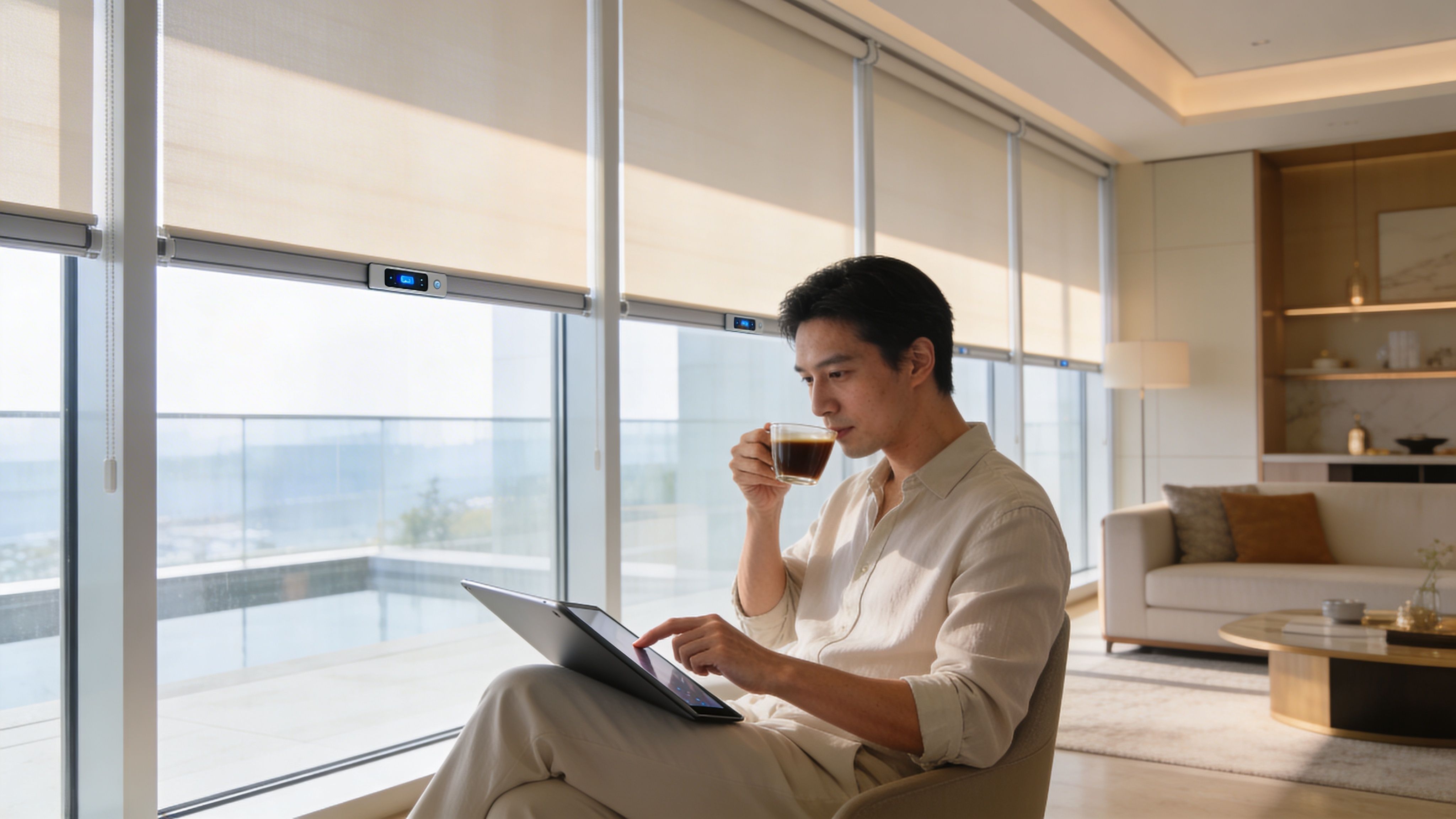
The reason is straightforward. Large windows, tall ceilings, and multiple exposures make manual operation inconsistent. A homeowner may lower one wall of shades in the afternoon but forget the stair hall, the upstairs landing, or the breakfast room that gets hit later in the day. Automation turns a series of good intentions into a system.
Why motorization changes performance
According to American Blinds’ overview of solar shades and smart-home features, the integration of AI-driven motorization has seen a 40% adoption increase in luxury smart homes, and systems from Somfy and Lutron can use sensors to adjust shades based on the sun’s position, reducing energy costs by up to 25%.
Those numbers matter because they reflect how the product is used. A manually operated shade has potential performance. An automated shade has scheduled performance.
In practical terms, that means:
- Great rooms stay usable: Afternoon glare can be managed before it hits the television wall.
- Skylights become manageable: Hard-to-reach openings no longer depend on ladders or neglect.
- Bedrooms feel more refined: Shades can lower at evening and rise on a schedule in the morning.
- Whole-home consistency improves: Multiple rooms respond together, rather than one window at a time.
For homeowners considering motorized shades and smart blinds for Armonk homes, the primary benefit is not novelty. It is reliable environmental control.
Best uses in Westchester homes
Motorization is particularly compelling in homes with architectural complexity.
A two-story family room in Purchase may have clerestory windows that no one wants to operate manually. A renovated estate in Rye may need discreet automation that respects original architecture. A new build in Greenwich may require shades to coordinate with lighting scenes and privacy settings across an open-plan first floor.
This is also where mixed systems become valuable. A project might combine solar shades in daytime living spaces, blackout rollers in bedrooms, and specialty solutions for angled or overhead openings, all tied into one control platform.
A short visual example helps show how these systems fit into daily life:
What does not work
Motorization fails when it is treated as an afterthought. Wiring paths, power planning, shade alignment, and control logic all matter. So does fabric selection. Automating the wrong fabric gives you a more convenient version of the wrong shade.
The strongest projects integrate automation early, especially when you are dealing with multiple exposures, large banks of windows, or layered treatments.
Actionable Design Tip: If a window is high, wide, frequently adjusted, or part of a larger grouping, discuss motorization immediately. Those are the openings where automation adds both comfort and visual order.
Why Expert Consultation and Installation Are Non-Negotiable
A custom shade is only as good as its specification and fit. In Westchester, that is not a minor detail. It is often the difference between a polished result and a room that still leaks light, traps heat unevenly, or looks unresolved.
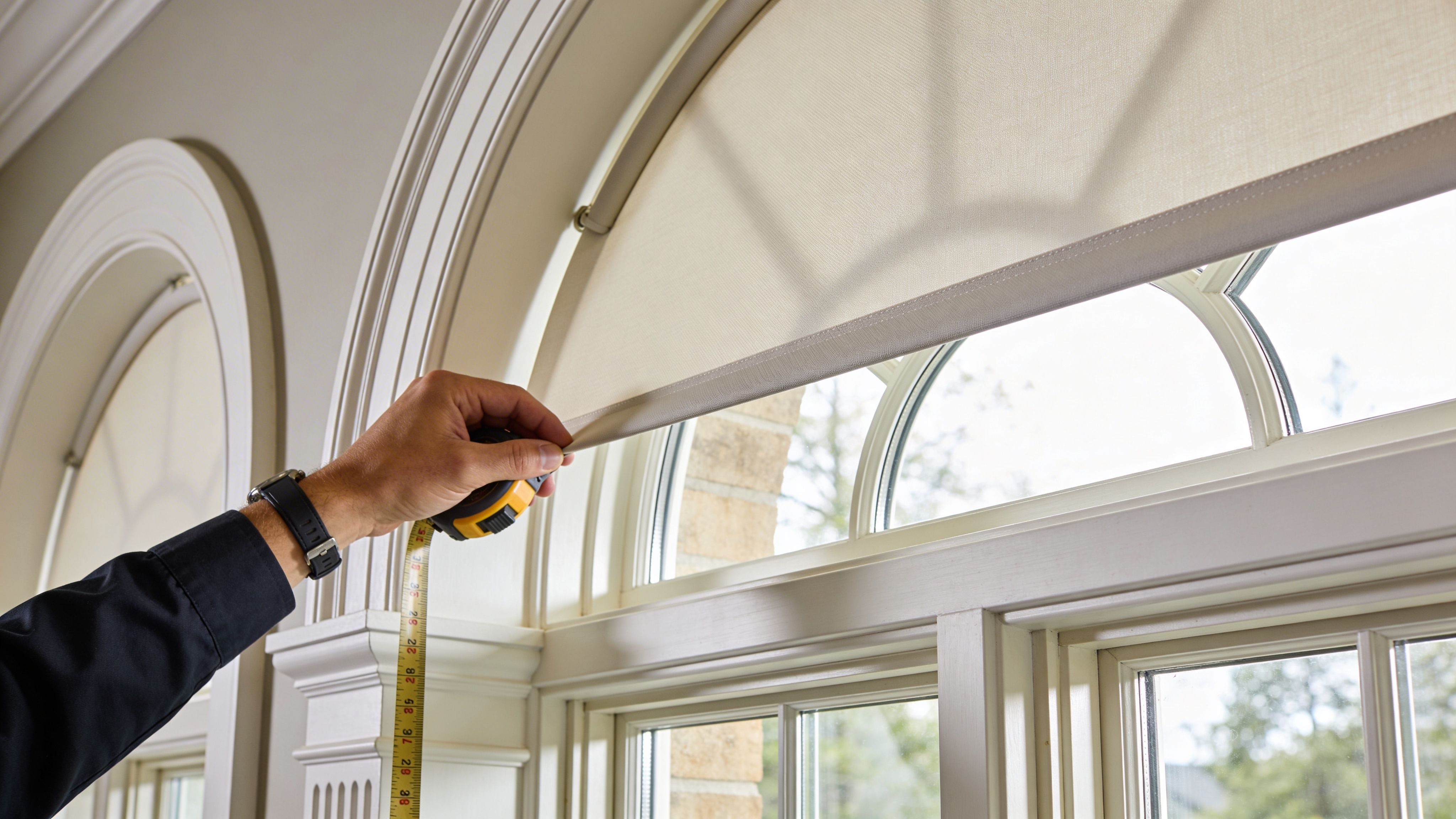
This becomes especially important in homes with architectural character. Vintage casings are not always perfectly square. Deep sills can affect stack and projection. Bay windows, arched openings, and angled glass demand more than standard product assumptions.
Complex architecture needs custom solutions
According to Blind Corners & Curves on arched and angled window trends, a 2025 architectural trend report noted 28% growth in custom angled and arched window installations in Northeast luxury markets, and expert consultation and installation are critical to ensure precise fitting without light gaps, preserving energy efficiency with up to 30% better insulation per DOE standards.
That reflects a reality we see often. Specialty windows are rarely forgiving. If the fabrication or installation is slightly off, the visual flaw is immediate and the performance flaw is ongoing.
In practical terms, professional guidance resolves issues such as:
- Light gaps at the perimeter: Common when openings are not perfectly true
- Improper fabric choice: A frequent problem when homeowners select for appearance before performance
- Misread privacy needs: Especially with products that work beautifully by day but not after dark
- Motorization conflicts: Where power, alignment, or control planning should have been addressed at the design stage
In-home consultation changes the decision quality
There is no substitute for seeing materials in the actual room. The same fabric can feel warm in one house and stark in another. Wall color, floor tone, trim detail, and exposure all influence the result.
That is why the mobile-showroom model matters. Reviewing fabrics beside your paint, upholstery, rugs, and millwork leads to better decisions than choosing from a small swatch under store lighting. It also allows us to specify one coherent house-wide approach while still tuning each room for performance.
We may recommend a tighter solar weave in one room, a softer insulating shade in another, and motorization only where daily operation demands it. That is not inconsistency. It is design discipline.
Installation is where the value is realized
Luxury homeowners often focus on fabric and finish, which is understandable. But installation is where the promise of the product becomes real.
A professionally installed treatment should sit correctly, move smoothly, align cleanly, and feel intentional within the architecture. It should also preserve the manufacturer’s warranty requirements and support long-term reliability, especially in whole-home and automated projects.
This is the point at which one mention of provider matters. Westchester Window Fashions handles in-home consultation, product specification, and professional installation for custom window treatment projects across Westchester, including specialty windows and integrated motorization systems.
Actionable Design Tip: If your home includes arches, angles, oversized glass, or a mix of old and new windows, treat consultation as part of the product, not an optional extra. That is where performance problems are prevented before they are installed.
Transform Your Home with Perfect Light Control
The right sun blocking blinds shades do more than soften a room. They protect interiors, support comfort, preserve views where appropriate, and bring a level of visual calm that most homes only achieve when light has been thoughtfully managed.
In Westchester, that process is rarely one-size-fits-all. A bright Colonial in Scarsdale, a historic home in Rye, and a contemporary renovation in Armonk can all need sun control for different reasons. One room may call for solar shades that preserve the outdoor view. Another may need insulating cellular shades. A third may only feel complete once motorization is added so the system works consistently every day.
What works is precision. Correct fabric. Correct openness or opacity. Correct mounting. Correct control system. Correct installation.
What does not work is assuming that any product labeled “sun blocking” will perform the same way in every room.
When those decisions are made well, the result feels effortless. Rooms stay usable throughout the day. Furnishings are better protected. Privacy improves where it should. The architecture reads more clearly because the light is under control instead of controlling the room.
Actionable Design Tip: Review your home room by room, not window by window. The strongest results come from a coordinated plan that respects how each space is used while maintaining a cohesive look throughout the house.
Schedule your Complimentary In-Home Design Consultation in Westchester with Westchester Window Fashions to evaluate sun exposure, compare curated materials in your own light, and develop a custom plan for elegant, high-performance window treatments.


