

A small bathroom window often becomes the last unresolved decision in an otherwise beautifully finished renovation. The tile is selected. The plumbing fixtures are in. The vanity feels proportioned and polished. Then the window remains, asking for privacy, softness, moisture resistance, and restraint, all at once.
In Westchester homes, that challenge tends to be even more specific. A compact window over a soaking tub in Rye, a narrow opening in a Scarsdale Colonial, or a charming leaded-glass bath window in a Bronxville Tudor all demand a more considered answer than an off-the-shelf covering. The right window treatment for small bathroom window conditions is not a minor accessory. It is part of how the room feels every morning and every evening.
The Finishing Touch Your Small Bathroom Deserves
We often see the same moment near the end of a bath project. A homeowner has invested in stone, millwork, and lighting that feel calm and intentional, yet the small bathroom window still looks unresolved. That single opening can interrupt the entire composition if the treatment is too bulky, too flimsy, or unsuited to humidity.
In a room where square inches matter, the wrong choice shows quickly. Heavy fabric can feel out of place. Generic blinds can cheapen a refined bath. Materials that are not meant for steam begin to betray themselves long before the rest of the room does.
What makes this decision more important today is that the market has moved decisively toward better-performing materials. The global window treatment market reached $20.8 billion in 2022, driven in part by demand for humidity-resistant materials such as PVC and polyester, as noted in this small bathroom window treatment market overview. That shift reflects what experienced designers and installers already know. Bathrooms punish weak materials.
For an affluent homeowner, the question is rarely just, “How do I cover the glass?” The better question is, “How do I finish this room in a way that protects privacy, respects the architecture, and still feels aligned with the rest of the house?”
What the room needs from the start
A successful bathroom treatment has to balance several demands at once:
- Privacy without heaviness so the room still feels open.
- Moisture resistance so the treatment maintains a refined appearance.
- Light control that suits morning routines and evening use.
- A profile that fits the scale of a compact opening.
- Design continuity with the rest of the home.
In a primary bath, that may mean something architectural and substantial. In a powder room, it may mean something visually quieter. The right answer depends on placement, humidity exposure, and the tone of the room.
Actionable Design Tip: Treat your small bathroom window as part of the finished architecture, not an accessory added at the end. If the rest of the room feels custom, the window treatment should carry that same level of intention.
Understanding the Small Bathroom Window Conundrum
A small bathroom window is difficult because its constraints overlap. Privacy matters more here than in almost any other room, yet natural light matters more too. Homeowners want coverage, but they do not want the room to feel closed in.
Privacy and daylight are in tension
In many baths, especially those facing neighboring properties, you need screening at eye level while still wanting daylight from above. That is why style matters less at first than functionality. The operating method has to match how you use the room.
Top-down or tilt-based control can be elegant when privacy is needed low on the glass and light is welcome above. Simpler fixed-position solutions can work well when the window is already placed high enough to protect sightlines.
Placement changes the decision too. A window over a vanity asks for daily precision. A window over a tub asks for convenience and safety. If you are still weighing categories, this guide on the difference between blinds and shades helps clarify which construction better suits your space.
Moisture is the silent filter
Bathrooms expose materials to repeated humidity cycles. Steam, condensation, and limited airflow all narrow the field of what performs well long term. Many attractive showroom choices fail in real homes under such conditions.
A treatment may look appropriate on day one and feel compromised a year later. Painted finishes can lose their crispness. Natural fibers can absorb moisture. Wood-based products can react in ways that are subtle at first and then difficult to ignore.
Small scale makes every mistake more visible
On a large living-room window, visual bulk can disappear into the room. On a small bathroom window, every headrail, stack, slat, and frame matters. If the treatment is overbuilt for the opening, the window looks smaller and the room follows.
This is especially true in classic Westchester architecture. A compact Tudor bath window may already have strong trim lines. A modern Armonk bath may rely on clean negative space. In both cases, proportion is doing as much work as privacy.
Off-the-shelf logic usually breaks down
Standard products assume standard conditions. Bathrooms rarely offer them. A high sill, a shallow casing, unusual trim depth, or a placement directly beside a shower changes what is sensible.
That is why the decision should begin with priorities, not product names.
Actionable Design Tip: Before choosing a style, observe how the light moves through your bathroom during the day and note when privacy matters most. That pattern often tells you whether a top-down feature or a tilting treatment will serve your routine more gracefully.
Material Mastery For Humid and High-Style Spaces
Material selection decides whether your bathroom treatment remains polished or starts looking compromised. In this room, appearance and performance cannot be separated.
What performs well in a bathroom
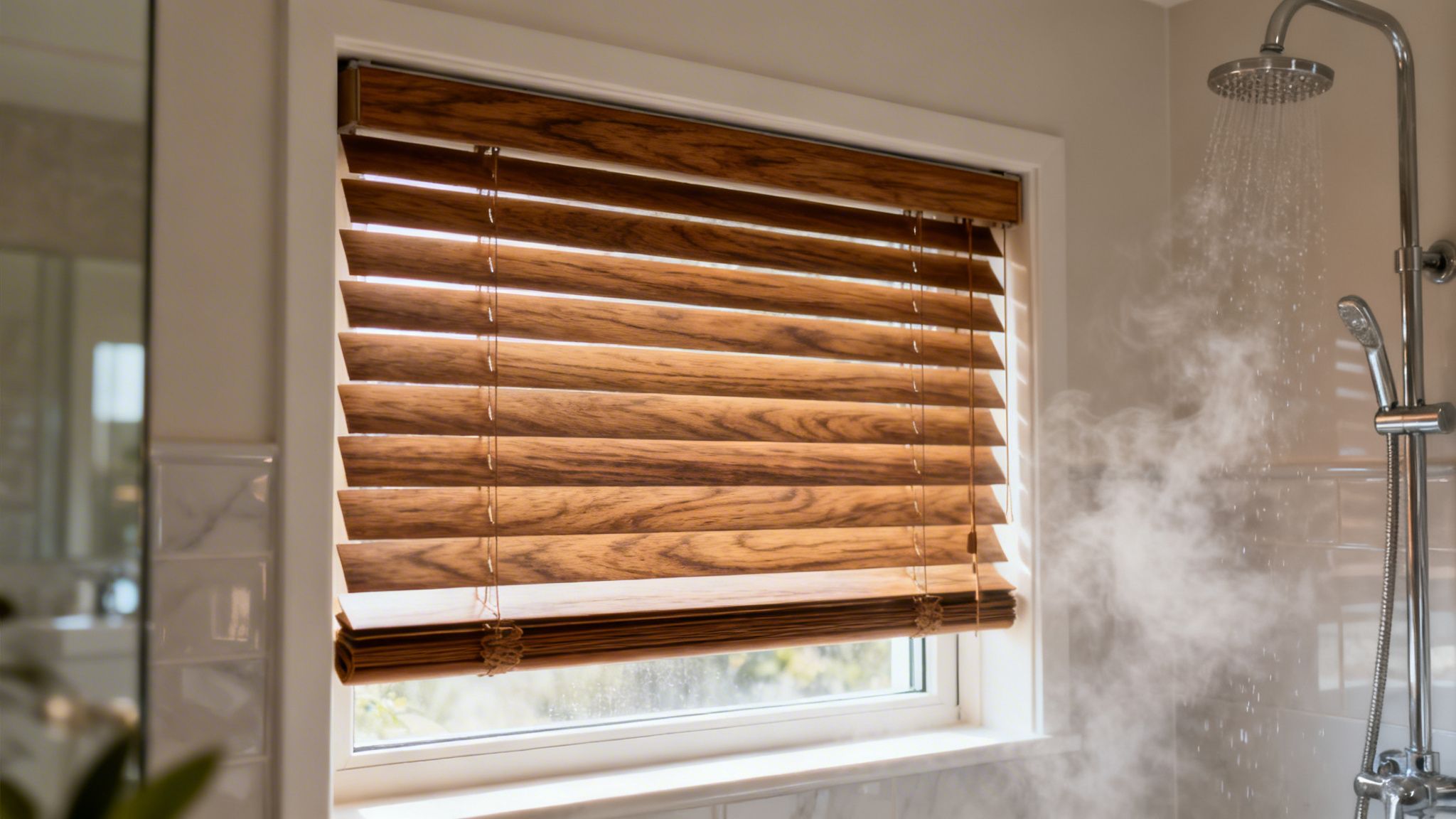
For small bathroom windows, we favor materials that resist moisture without looking utilitarian. Composite and faux wood products give structure and definition. Performance textiles offer a softer visual effect while still standing up to bathroom conditions. High-quality synthetics can be refined when the finish, weight, and fabrication are right.
Cellular shades are especially useful when comfort matters as much as privacy. According to this review of motorized window treatment performance and cellular insulation, cellular shades can deliver R-values up to 4.5 in double-cell configurations and can minimize heat loss or gain by 40% or more. In a Westchester winter, that matters on a cold bath window. In summer, it helps the room feel less exposed to harsh solar gain.
Materials we approach with caution
Real wood is the most common misstep. It can be beautiful elsewhere in the home, but bathrooms ask too much of it. Repeated moisture exposure invites movement, finish stress, and long-term instability. In a room intended to feel serene and pristine, that is not a trade-off worth making.
Delicate fabrics can also be problematic, particularly when they are used in tight spaces with poor ventilation. They may soften the room visually, but they often introduce maintenance concerns and a less refined profile than a compact opening can tolerate.
Matching material to design intent
Different bathroom styles call for different material expressions:
- Faux wood or composite constructions suit traditional baths, painted millwork, and homes with established architectural detailing.
- Moisture-tolerant cellular fabrics work well when comfort, softness, and insulation are priorities.
- Refined roller shade textiles make sense in modern or transitional spaces where the goal is a minimal profile.
- Waterproof shutter materials support a more permanent, architectural look.
For homeowners comparing adjacent rooms, it can be helpful to see how material choices shift across spaces. This perspective on modern kitchen window coverings is useful because kitchens and baths both demand performance, but in very different visual ways.
Actionable Design Tip: During an in-home consultation, ask to handle materials side by side. The difference between a lightweight basic vinyl product and a well-finished composite or performance textile is usually obvious in the hand and even more obvious once installed.
Comparing the Best Bathroom Window Treatment Styles
Style is where function becomes visible. The strongest options for a small bathroom window do not all behave the same way, even when they look equally polished in a showroom.
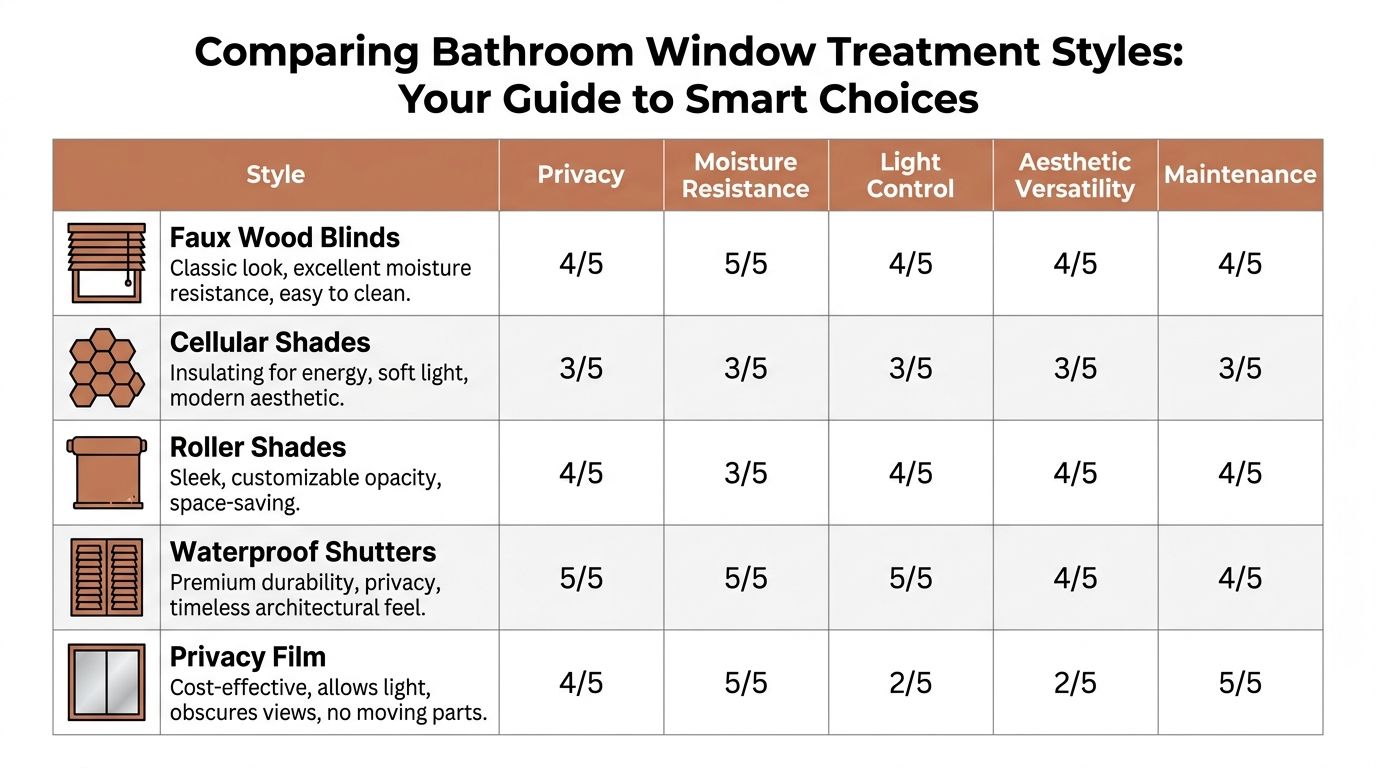
Small Bathroom Window Treatment Comparison
| Style | Privacy Control | Moisture Resistance | Insulation Value | Best For |
|---|---|---|---|---|
| Plantation shutters | Excellent with adjustable louvers | Strong when specified in waterproof materials | Moderate | Traditional and transitional baths that benefit from architectural presence |
| Cellular shades | Strong, especially in top-down configurations | Good when bathroom-suitable fabrics are selected | High | Homeowners prioritizing comfort, softness, and reduced drafts |
| Roller shades | Good, depending on fabric opacity | Good with performance textiles | Moderate | Minimal, clean-lined bathrooms with limited visual space |
| Faux wood blinds | Very good with tilt control | Strong | Moderate | Classic baths where directional light control matters |
The trade-offs are practical.
Plantation shutters
Shutters feel permanent. They become part of the room rather than something applied to it. In a well-detailed bath, that permanence can be exactly right.
They are especially successful in homes with strong trim language, such as Colonials and Tudors. The caution is scale. On a very tiny window, the frame can become visually dominant if not carefully specified.
Cellular shades
Cellular shades are often the quiet achiever. They soften light, help with comfort, and keep a narrow profile. In bathrooms that feel chilly near glass, they can improve the daily experience in a way homeowners notice immediately. Windows are a major energy weak point. The U.S. Department of Energy notes that 30% of a home’s heating energy is lost through windows, and 76% of sunlight entering standard double-pane windows becomes unwanted heat during cooling season, according to its guide on energy-efficient window coverings. If your bathroom runs hot in summer or cold in winter, insulating treatments are not a decorative luxury.
Roller shades
Roller shades serve a very different purpose. They reduce visual clutter. In a compact powder room or a contemporary bath, that restraint can be the smartest move.
Their limitation is that they offer less nuanced control than louvers or top-down configurations. They tend to be better for homeowners who prefer a clean, decisive privacy solution over granular adjustment.
Actionable Design Tip: Judge style by visual weight, not just by appearance. In a compact powder room, a low-profile roller often preserves openness. In a larger primary bath, shutters can add the architectural substance the room needs.
The Smart Solution Motorization for Effortless Control
Motorization belongs in the bathroom for practical reasons first. Small bath windows are often placed where manual operation is awkward, disruptive, or unsafe. Over a tub, behind a freestanding soaking tub, or high on a wall, the right control method matters as much as the fabric or finish.
The market is moving in that direction. According to this article on bathroom window treatment trends and automation, 72% of luxury bathroom remodels in major U.S. markets prioritize app or voice control, and those automated adjustments can support energy savings of up to 25% through more precise management of insulation and light exposure.
Convenience is only part of the story
Motorization removes cords and awkward reaches. That makes the room feel cleaner visually and simpler to use day to day. In family homes, cordless operation is also the safer, more orderly choice.
It also changes how consistently the treatment gets used. Manual bathroom shades often remain in one position because adjusting them is inconvenient. Automated operation encourages proper use throughout the day, which means privacy and daylight become part of the routine rather than a recurring compromise.
The video below gives a useful sense of how automated operation fits into modern window-covering use.
Integration matters in a luxury home
A small bathroom treatment should not feel isolated from the rest of the house. In higher-end homes, bath windows are increasingly part of whole-home scenes that include bedroom shades, media-room controls, and main living spaces.
Systems compatible with Lutron and Somfy allow a bath treatment to rise, lower, or tilt with the same logic as the rest of the home. For homeowners exploring this category, this overview of motorized shades and smart blinds in Armonk shows how these systems can be incorporated more broadly.
Where motorization solves a real design problem
Motorization is especially persuasive when the treatment must be beautiful and discreet. A manually operated shade can introduce chains, cords, or control hardware that interrupts the room. Automated operation preserves cleaner lines.
Westchester Window Fashions offers in-home design consultation and professional installation for motorized shades and blinds that integrate with broader smart-home systems, which is particularly useful when a bathroom project is part of a larger whole-home plan.
Actionable Design Tip: Think in terms of routine, not gadgetry. If your bathroom window needs privacy at dusk, daylight in the morning, and easy operation over a tub or vanity, automation turns the treatment into a dependable part of daily living.
Custom Solutions for Classic Westchester Architecture
Many of the most beautiful homes in Westchester refuse standard sizing. That is part of their charm. It is also why small bathroom windows often become complicated.
A dormer bath may have an angled opening. A renovated attic suite may have a sloped wall with a narrow window tucked into it. A historic home may include arches, unusual casing depths, or charming proportions that generic products flatten rather than respect.
Non-standard windows need custom logic
Mass-market advice usually assumes a rectangular opening with forgiving tolerances. That assumption falls apart in older and architecturally distinctive homes. A treatment that almost fits is usually worse than no treatment at all because it calls attention to the mismatch.
Custom fabrication changes that outcome. It allows the treatment to support the architecture rather than compete with it. On an arched bathroom window, a properly designed shutter can feel original to the house. On a tight angled opening, a custom shade can preserve both privacy and the line of the wall.
Why this matters more now
Design reports indicate that a significant number of Northeast remodels are projected to involve smart-motorized treatments for non-standard windows, as discussed in resources on angle-top and specialty window treatments. Framed as a projection for that remodel cycle, the point is clear. Homeowners are no longer willing to treat unusual windows as afterthoughts.
That is particularly relevant in baths, where unusual windows are often also hard to reach. Once shape and access challenges overlap, custom design and professional installation stop being optional refinements. They become the only route to a coherent result.
Preserving character while improving use
The best custom bathroom treatment does two things at once. It makes the window easier to live with, and it protects what made the window worth preserving in the first place.
That is important in Greenwich estates, Scarsdale Colonials, and older homes throughout Westchester where architectural identity carries real value. A small bathroom window may not be the largest feature in the room, but it often carries more character than anything else there.
Actionable Design Tip: If your bathroom window is arched, angled, narrow, or otherwise unusual, do not force it into a standard solution. The shape itself can become one of the room’s strongest design assets when the treatment is designed specifically for it.
Your Complimentary In-Home Design Consultation
A small bathroom window tends to expose the difference between a generic product choice and a resolved room. The right answer is rarely based on style alone. It is a combination of moisture-appropriate material, proportion, privacy control, and, in many homes, smart integration.
That is why the common assumption that a bathroom window is too small to require expert attention is usually wrong. Small windows are less forgiving, not more. Their scale makes visual missteps more obvious, and their location makes performance more demanding.
An in-home consultation changes the quality of the decision. Seeing materials in your own light, against your tile, trim, and hardware, often clarifies the choice immediately. So does evaluating whether the treatment should disappear, contribute architectural weight, or integrate into a larger motorized plan for the home.
For homeowners who value a finished result, professional guidance is not an added layer. It is what protects the investment you have already made in the room.
Actionable Design Tip: If you are deciding between two strong options, evaluate them in the actual bathroom rather than in abstraction. Light direction, trim depth, and sightlines from neighboring homes often settle the question faster than a showroom sample ever can.
Schedule a Complimentary In-Home Design Consultation in Westchester with Westchester Window Fashions to review custom options for your small bathroom window in the context of your home’s architecture, lighting, and smart-home goals. We bring curated samples directly to you, assess the room in person, and help specify a solution that feels polished, durable, and properly integrated from the start.


